
War 2.0 Is Live
It is live. The patch went in this morning, and the world you logged out of is not the world you are logging into.
The announcements of the last week described what was coming. This article describes what is running. Where an earlier article gave a figure that changed before release, the figure below is the one the server actually uses. Keep this page — it is the ruleset you will be arguing about for the next months.
What happened to your things
Every player war was closed. No winner was declared and no territory changed hands. Regions sit exactly where they stood.
Anything you took under the old rules is permanently yours. Old conquests were not reverted and are not marked as provisional occupations. They will never revert on a deadline.
No peace treaty came out of the closure. Any congress can table a declaration of war right now.
Your stored warheads are gone, and you were paid for them. Every region's nuclear stock was cleared and the value returned to national treasuries and national storage. Presidents should check both before doing anything else.
If you were watching a battle when the wars closed, your client named the defender as the winner. There is no frame for "annulled" to send you. Nothing moved, and nothing moving is the true territorial outcome.
Declarations and invasions are open again. Peace bills were never blocked during the freeze.
I. A declaration of war now names a clock and a prize
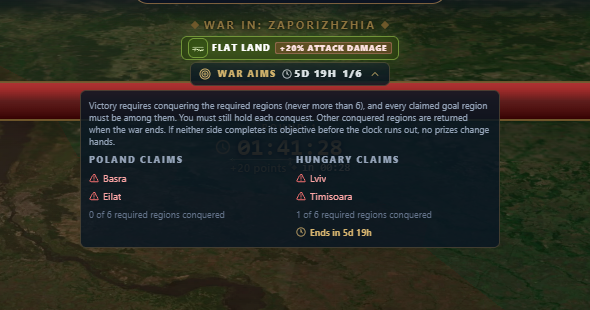
Wars ran forever because nothing ended them, and against a large nation the only victory condition — erase the country — was never going to happen. A declaration is now a licence with a deadline and a stated aim, bought by congress.
The bill must name a duration: 7, 14, 21 or 30 days. No other value is accepted, at submission or at enactment.
It must name zero, one or two goal regions of the target.
The target must rule at least one contestable region, or the bill is denied at enactment and the treasury refunded.
A legacy bill with no duration and no goals is denied the same way. There is no such thing as a war without aims any more.
What it costs
The base war price scales with the populations of both countries, is then multiplied by the clock you buy, and is then adjusted by your congress's ideology. The proposal screen quotes the exact figure before you table it, so read it there rather than budgeting from memory.
Duration | Price multiplier |
7 days | 1.00x |
14 days | 2.00x |
21 days | 3.00x |
30 days | 4.29x |
A congress's free first proposal covers a 7-day war only. A 14, 21 or 30-day licence always pays its duration-scaled price, so a brand-new congress cannot vote itself a free month of conquest.
What winning requires
When the vote passes: the smaller of 6, or the number of contestable regions your opponent ruled at that moment.
To win you must hold at least that many regions you personally conquered from the opponent under this declaration — and every region you named as a goal must be among them. Six captures that miss your goals settle nothing. The goals are the point; the count is only the price of admission.
A conquest counts only while you still rule it. A third country's conquests never complete your objective, and your objective is never completed merely by your enemy's region count falling.
There is one further route. If the opponent owns nothing you do not already rule, you rule at least one region it still owns, and you hold at least one qualifying conquest, the objective completes. Your declared goals stay mandatory. You cannot be asked to take ground that no longer belongs to your enemy.
A country ruling zero regions may still declare, but every goal it names must be one of its own rightful regions currently held by the target. That is the one exception, and it exists so a wiped nation always has a road home.
Invasions are strategic only
Starting a battle against a playable country now requires a live war relation and an active declaration. The old shortcut — "this region is rightfully mine, so I can attack it whenever I like" — is gone. A lost core is recovered by naming it as a war goal.
An invasion costs 10 Gold, or 15 Gold where you share no border with the target region. Retaking your own capital is free.
One invasion per target country at a time. Lose a battle against a country and you must wait a full battle length before attacking it again.
The country that declared holds 24 hours of initiative to open the first battle.
A battle is nine rounds, and a round currently runs 160 minutes — so a full battle is about 24 hours. Plan your duration around that: a 7-day licence is roughly seven battles.
You cannot start a battle that could not finish before your deadline. The war HUD says so instead of letting the click fail, and tells you roughly how many battles still fit.
II. Winning a battle takes an occupation, not a region
This is the biggest change to how the map feels. A battle win no longer hands you ownership. It hands you a provisional occupation, and the occupation is only settled when the war is.
The work tax splits. While the governing declaration is active and inside its deadline, the occupier collects 80% and the country the region reverts to keeps 20%. The region screen names both countries and prints the split.
That 20% goes to the region's recorded owner — the country it will return to — not necessarily to whoever you most recently took it from.
No buildings are damaged by occupation. Holding ground no longer wrecks it. Damage happens only at final settlement.
Regions occupied under the old rules pay their whole work tax to the occupier, as before. That is not a bug: they were never provisional.
Occupation is not a shield. A war is fought against a country's territory, not against whoever is standing on it. Ground owned by a nation you are at war with stays contestable even when a third country occupies it, and the occupier defends, because its troops are on the field. You do not need to declare war on the occupier. A non-aggression pact with them still protects them everywhere.
Provisional occupation only exists under a declaration. The battles that still bypass the strategic gate — event and NPC regions — remain permanent on contact, with no occupation, no split and no hatching.
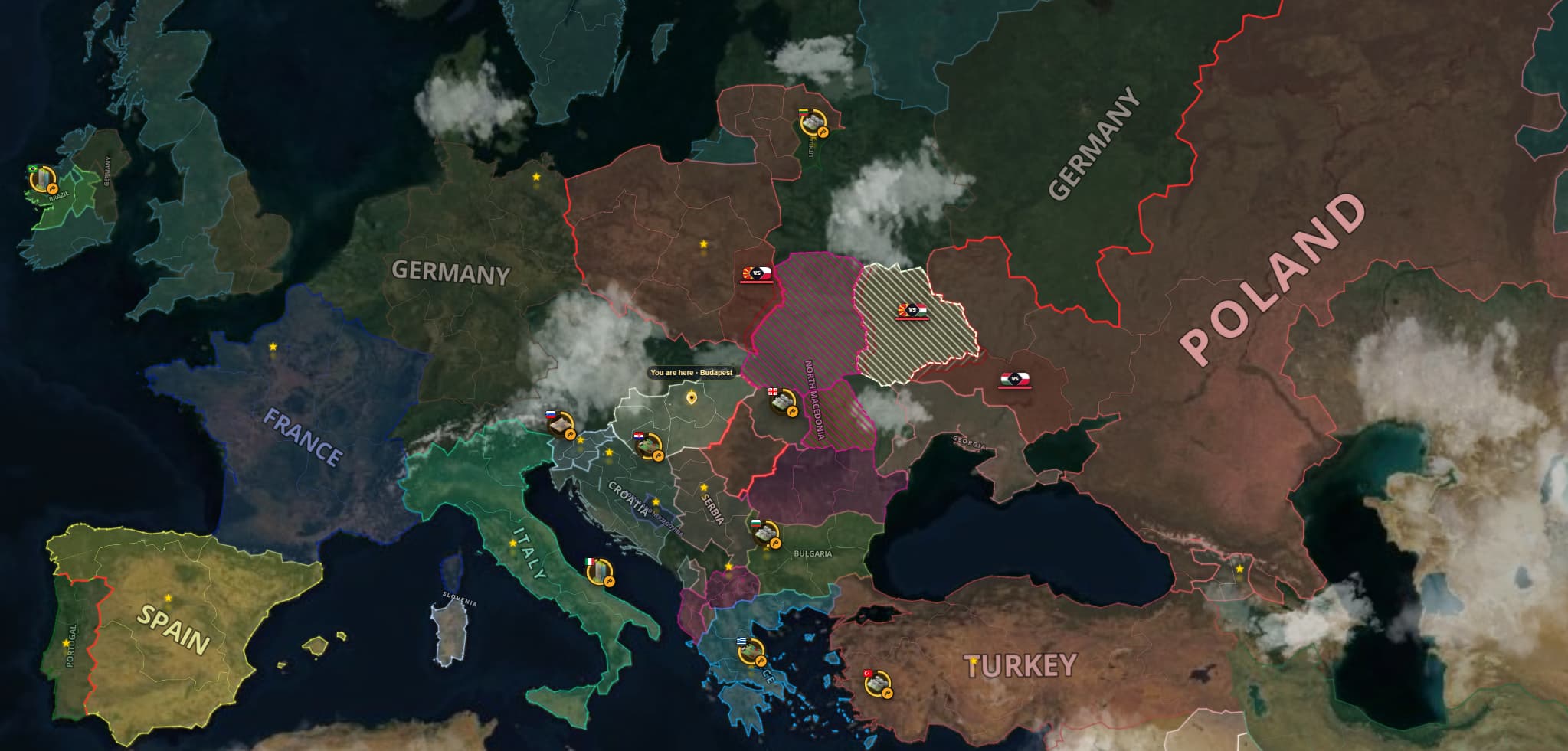
On the political map view a provisionally occupied region keeps its rightful owner's fill colour and gains 45-degree diagonal stripes and a dashed border in the occupier's colour. The fill says whose it is; the stripes say who is sitting on it. The marks appear within about a minute of a conquest. In the economic, cultural, connections and terrain layers an occupied region draws as ordinary territory.
III. Ending a war
Outcomes are resolved in a fixed order, every minute.
Settlement
When a war resolves in someone's favour, in a single step: the winner keeps only its declared goals, and only those it conquered and still rules. Every other occupation is released — including regions the winner rightfully owns but did not name. Each region kept loses one level from every building that has one, exactly once; this is the only moment a declared war damages buildings. Active building orders are cancelled in every region a settlement touches, in both directions. The battles between the pair stop, the war relation closes, and a 7-day non-aggression pact is signed automatically.
The deadline
If nobody completed their objective when the clock runs out, nothing changes hands. Every occupation is released to its recorded owner, running battles are cut short, and the war closes. The 7-day pact is signed on that outcome too — which was never announced and matters a great deal: a war you cannot finish costs you a week before you can re-declare against that country. A war you cannot finish is a war you lose by default.
The defending congress can play for territory
Surviving is no longer the only prize available to a defender. A bill — Add war objective — names up to two of the attacker's regions to claim: no population scaling and no ideology modifier, so a small country pays the same to answer a large aggressor, and it is free if it is that congress's first proposal of the term.
Buy it from your country's governance screen. It is a congress bill, not a button on the war page. The window is not a choice — it always runs to the attacker's own deadline. The purchase is refused when less than one full nine-round battle would fit before that deadline, and it is unavailable entirely when the attacker declared while holding no regions. A defender that reaches the threshold without having bought an objective simply ends the war and takes nothing.
Surrender
A congress that has lost can end a war on terms instead of waiting out the clock, and the bill is free — charging a country to admit defeat would price the one action that ends a war it is already losing.
Total surrender concedes every goal region the winner currently holds.
Partial surrender concedes exactly one of them.
Everything else the winner holds returns to you, the war ends, and a non-aggression pact is signed. Only goals the winner actually holds can be conceded, so a war with a single held goal offers the total option only. A region that another live declaration names as a mandatory goal cannot be surrendered at all — refused at submission and again at promulgation, with the congress screen naming the blocked regions rather than offering an option the server will reject.
One caveat worth planning around: either side may file it, but an attacker's surrender only works if the defender bought an objective and holds one of its goals. Do not treat it as a general exit.
Annulment
If another war's settlement permanently awards a region your declaration named as a mandatory goal, your declaration closes as annulled: no prizes, every occupation released, and deliberately no pact, so your congress may declare again at once. A public world event names both countries and the lost region, and your president and congress receive a notice.
IV. Alliances now decide damage
Alliances have been diplomatic paperwork. They are now a combat statistic.
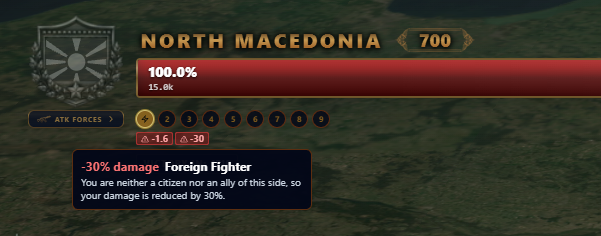
Foreign Fighter: -30% damage. If you are neither a citizen of the side you are fighting for, nor a citizen of one of its formal allies, your damage is cut by 30%.
The penalty applies after all of your bonuses — buffs, squad, studies, equipment. You cannot stack your way out of it. The more powerful the mercenary, the more it costs them.
It does not apply in training wars, tournament wars, or against event and boss armies. Those have no nationality dimension and are meant for everyone.
Liberating a wiped or disabled nation is exempt. A dead country has no government left to sign an alliance with, and it must never become permanently unreclaimable.
Your row on the war scoreboard shows the penalty when it is being applied.
Two related changes ship with it. You can no longer propose an alliance with a country you are at war with — end the war first, and the proposal is refused at submission. And wartime pricing is now shared: each active war involving either country multiplies the fee by three, across alliance, extradition, citizenship and company relocation alike. A war bill still on the congress floor counts.
Active wars | Fee multiplier |
0 | x1 |
1 | x3 |
2 | x6 |
3 | x9 |
A declaration of war's own price is not multiplied this way — it scales by population and duration. Diplomacy conducted under fire is expensive; making war is priced separately.
V. Battle prizes are shared by damage
Only the top fighter on each side was paid, so a round that half a country turned up for rewarded one player. Every side of every round now has its own prize pool, divided among that side's players in proportion to the damage each dealt.
Player damage on your side | Pool for that side |
under 100,000 | nothing |
100,000 | 2 Gold |
400,000 | 4 Gold |
1,600,000 | 8 Gold |
6,400,000 | 16 Gold |
25,600,000 | 32 Gold |
102,400,000 | 64 Gold |
The steps are not cumulative. Reaching a new threshold replaces the pool; it does not add to it.
Both sides are paid every round, whether they won it or lost it.
Only player damage counts. NPC damage neither raises the tier nor dilutes your share.
Your share is your percentage of your side's player damage. Deal 30% of it and you take 30% of the pool. You do not need to place first, or to appear in the visible top 100.
The split is 40% direct Gold and 60% Piggy Bank. Amounts round down to hundredths of a Gold, and a share below 0.01 Gold pays nothing.
The Piggy Bank still stops at 30 Gold, and the overflow is discarded rather than converted into Gold. Your direct-Gold portion is never reduced by a full bank.
A worked example. A side deals 500,000 player damage, so the pool is 4 Gold. Three players dealt 250,000, 150,000 and 100,000. They receive 0.80, 0.48 and 0.32 Gold directly, and 1.20, 0.72 and 0.48 Gold into their Piggy Banks.
Say it plainly: the old flat prize is gone
The number-one fighter used to bank a guaranteed 2 Gold plus 3 Gold of Piggy Bank — 5 Gold of value — and 0.1 Gold in tournaments. That payout no longer exists. The top fighter keeps the medal and takes the largest proportional share instead. On a side that only just clears 100,000 damage the entire pool is 2 Gold shared among everyone, so the leader of a small battle can walk away with less than before, while everyone else walks away with something. That is the trade, and it is deliberate.
Training and tournaments
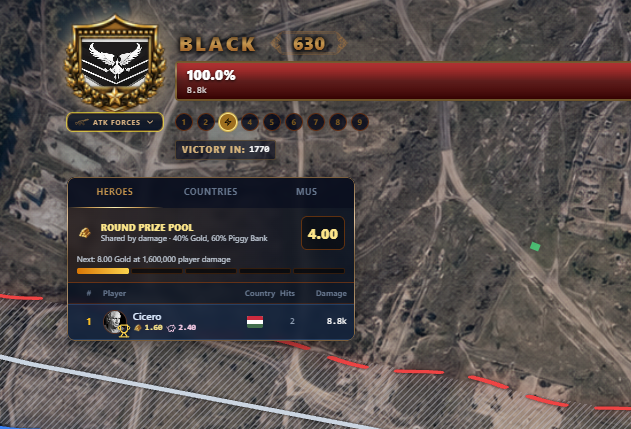
The daily Black vs White training war guarantees 4 Gold per side per round, advertised before the first hit, with the next step at 8 Gold on 1,600,000 player damage. You must still deal damage to take a share; the guaranteed pool alone pays nobody.
Event and tournament battles use the same sharing at exactly one fiftieth of the amounts — 0.04 Gold at the first threshold through 1.28 Gold at the top — and never inherit the training floor.
The medal stays exclusive
The Battle Hero medal is still one per side per round, to the number-one damage dealer only, and it still counts for its quest and for the championship. Sharing the Gold does not mean sharing the medal.
If an NPC finishes first on a side, nobody there earns the medal — but the players are still paid their shares.
Open the ATK or DEF Forces leaderboard to watch the pool build: the current pool, a meter to the next tier, and an estimated Gold and Piggy Bank figure under every player's name. Your own row uses your private full round damage, so it is correct even when you are outside the visible ranking.
The Piggy Bank figure on a row is your whole share before the 30 Gold cap. What is actually deposited depends on the space left when the round pays out.
Piggy Bank balances now hold fractions of a Gold, which is what lets small shares survive at all.
Payouts appear in your Gold history as Round damage reward. Fighting on both sides of the same round earns a share from each.
Rounds settled before today keep the rewards they were actually paid, and their reports still describe the old hero prize. That is intended.
Players on the legacy 1.6 war screen get the prize bar too.
One piece of housekeeping, since this section is about to change how you play: empty your Piggy Bank before a large battle, because 60% of every reward lands there and anything above 30 Gold is discarded. Breaking it costs 30 gems and pays out the whole accrued balance.
VI. The nuclear rebalance
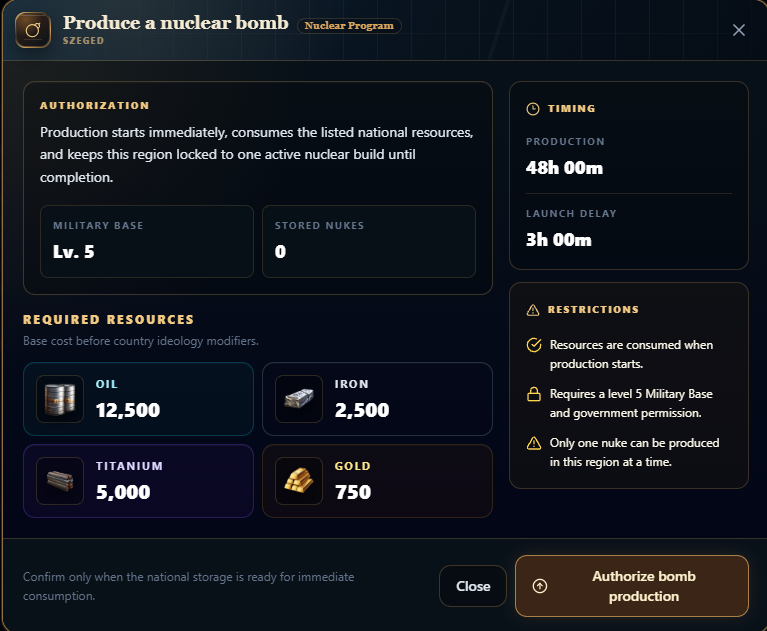
The bomb was too cheap and too weak. It cost less than a decent weapon and knocked one level off two random buildings. Both halves are fixed at once.
Before | Now | |
Gold | 30 | 750 |
Oil | 500 | 12,500 |
Iron | 100 | 2,500 |
Titanium | 200 | 5,000 |
Flight time | 3 hours | 8 hours |
Flight time is 8 hours, flat, for every country. The 28 August article said three hours; that figure is dead. Centralism's flight-time reduction has been removed and no ideology shortens it any more, so a launched warhead is visible to the entire world — including to players who are not logged in — for eight hours. Impact lands on the engine tick after the eight-hour mark, so treat it as eight hours after launch rather than to the minute.
Production is otherwise unchanged: a level 5 Military Base, a government office to authorise it, 48 hours, and one nuclear build per region at a time. Launching also needs a level 5 base and a government office, is blocked while the launching region is under invasion, and the target's country must be an active playable nation.
What a hit does now
A nuclear strike no longer nicks a couple of buildings. It removes a region from the war.
The target region is levelled. Every building drops to level 0 — hospital, military base, production fields, industrial zone, and any event or special structure it holds.
Every warhead stored in the target region is destroyed. A first strike on an arsenal is now a real strategy.
Each connected region loses one level from one random standing building. If the dice pick its Military Base, the warheads stored there burn too.
Construction is set back. A build order in progress on a damaged building has its target level lowered by the levels just lost, floored at 1, so the rebuild does not silently resume aiming at the old level.
The strike report was rebuilt to match: every impact carries its region name and is marked as the primary target or a connected region, with the level before, the level after and the levels lost. The production panel now shows a real progress bar with time remaining and a ready-at stamp instead of the words "In progress", and its iron and titanium icons are no longer swapped.
VII. Counter-nuclear: the Secret Agent
A weapon this powerful needs an answer that is not another weapon. The Secret Agent study turns eight hours of flight time into a window somebody can act in.
The study is learned at a level 4 Military Base in a region ruled by your own nation. Governments can leave it open or restrict it to an invite-only list of their own citizens. It unlocks two operations, and both run against the Military Base of the region you are standing in.
Recognition — find out what is there
Infiltrate the base to read its nuclear stock. It requires a level 5 Military Base, costs nothing, and puts itself on a 24-hour cooldown on every attempt, successful or not.
Outcome | Chance | Result |
Great success | 70% | Intelligence secured — you remain hidden |
Success | 20% | Intelligence secured — your identity is revealed |
Failure | 10% | No intelligence — your identity is revealed |
Defuse — destroy the stockpile
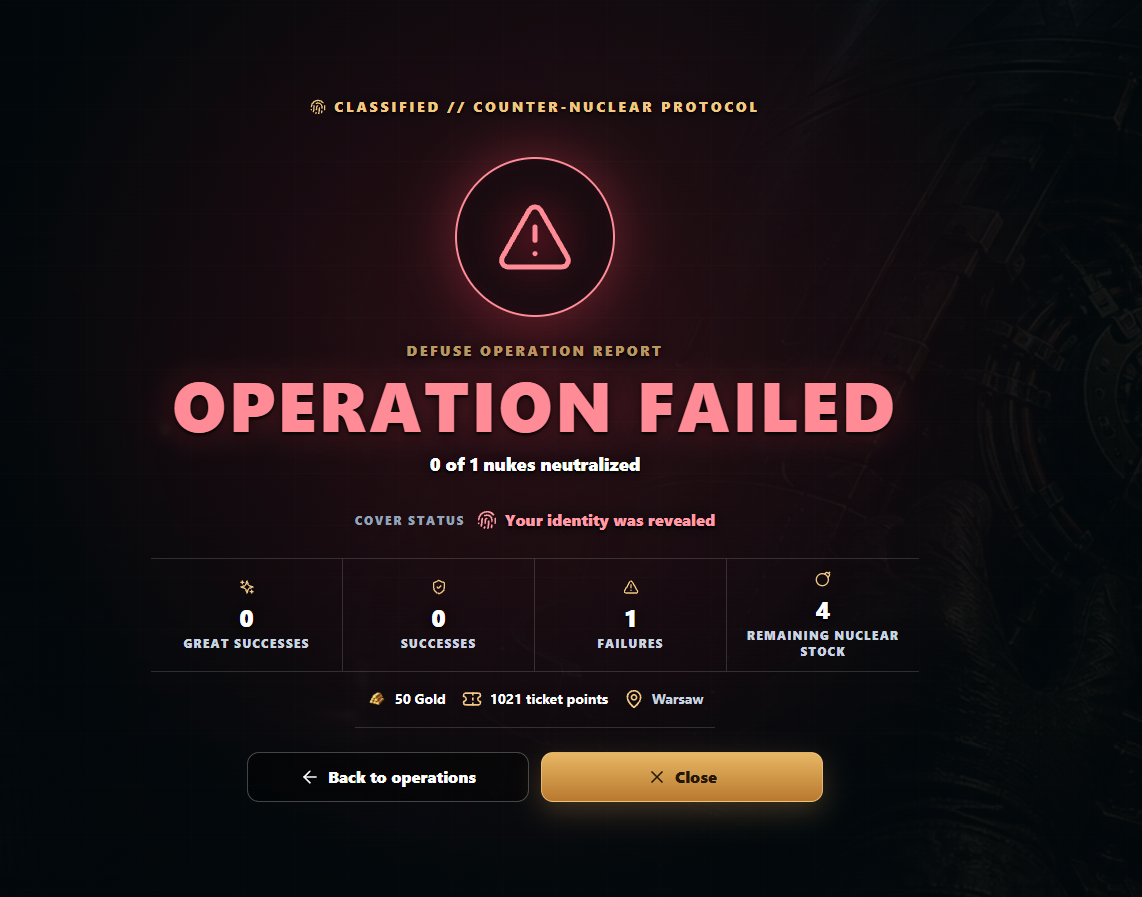
A successful Recognition report names a region and the stock it holds. Defuse spends that report. You must still be in the region, and you choose how many of the observed warheads to attempt. Each attempted warhead costs 50 Gold and 1,000 ticket pollution points from your own ticket qualities, and each is rolled independently.
Outcome | Chance per warhead | Result |
Great success | 25% | Warhead destroyed — you remain hidden |
Success | 25% | Warhead destroyed — your identity is revealed |
Failure | 50% | Warhead survives — your identity is revealed |
Any ordinary success or failure exposes you once for the entire operation, not once per warhead — so a large batch is not a larger risk of exposure, only a larger bill. If the region's live stock no longer covers what you asked for, the operation returns stale intelligence before charging you anything.
Get caught and the world finds out. Exposure publishes a Nuclear Sabotage event naming the agent, their nationality and the region — which is, of course, an excellent reason for somebody to declare war.

VIII. Centralism
Centralism used to tax its own nuclear programme and be paid for it in extra targets. That is inverted. Every effect scales linearly with Centralist representation in congress — 10% of the seats gives 10% of the effect, with no majority to cross — and the figures below are the value at full representation.
Effect | Per 1% of congress | At 100% |
Nuclear production time | -0.5% | 24 hours instead of 48 |
Nuclear production cost | -0.2% | 600 Gold, 10,000 Oil, 2,000 Iron, 4,000 Titanium |
Citizens' damage bonus | -0.1 points | -10 points of damage bonus |
Building energy donation progress | +1% | +100% |
Military Base upgrade points needed | +0.25% | +25%, at every level |
Cost to start or upgrade a building | +1.5% | +150% |
The damage penalty is unconditional: it applies to every hit its citizens land, on either side, in any region, in wars and NPC fights alike — not only at home. It subtracts from the national damage bonus rather than from the final hit, so a fighter already carrying other bonuses loses proportionally less than the headline figure suggests.
Two old perks are gone. Centralism no longer shortens missile flight time, and the extra-nuclear-target bonus has been removed — that one was real and working until today: above roughly half the congress, a Centralist warhead hit three random buildings instead of two.
The trade is clear: quicker, cheaper warheads and stronger building-energy contributions, paid for with weaker citizen damage and more demanding construction.
IX. Revolutions are retired
This needs saying plainly, because the preparation notices read like a temporary switch. Revolutions are not coming back. There is no route left to start one; only already-running legacy battles are allowed to drain, and a war bill against a pair with one still active is refused until it finishes.
Recovering a lost core is now done by naming it as a goal in a declaration of war. That is the replacement, and it is a better one: the claim is public, priced, and on a clock.
X. The Library
Everything that has happened in this world has been recorded in a database and read by nobody. The Library turns it into something you can actually read. Every nation with a recorded past now has a shelf.
Find it under Community → Library, from level 2, or at /library directly.
Shelves are ordered most-recently-active first. Only nations with a recorded past appear, and an era holding fewer than six entries is not published at all.
A volume opens as a book: the timeline on one page and the written chronicle on the other. On a phone it becomes one leaf you turn.
Read the timeline first. It is complete and readable immediately, whatever state the prose is in — every war declared, region conquered, alliance signed, election held, in order — and every nation, region and named president in it links to that entity's own screen. Dates are given in in-world day numbers, the same counter the HUD shows.
Weather and finished construction stay out of the history books. Wars, conquests, elections and nuclear strikes go in.
A volume opens with the first thing that happens to a country and stays open while its history keeps moving. After five days of national silence the era is considered closed and is queued for a chronicler, who writes it up in chapters as national history rather than as a log. Expect timelines now and chapters to fill in over the following days.
A volume is written once, in English. A nation's president, vice-president or public relations officer can commission a translation of any volume — not only their own country's — for 200 Gold from that nation's treasury. Only a closed, already-written volume can be translated.
The result is not private. Once a translation exists it is part of the Library permanently, served free to every reader who picks that language, forever. Paying for a translation of your rival's history is a perfectly reasonable act of statecraft. A translation that never completes refunds the treasury automatically and frees the language to be bought again.
XI. Chat: build your own groups, and send pictures
This was never announced, and outside the war rework it is the largest thing in the patch.
Custom groups
From level 5 you can open a private group, name it (2 to 40 characters), give it a picture and add the players you choose. Being added to one needs no level at all.
A group holds 50 members including you. You can pick up to 49 others when creating it, and add up to 20 per later request.
You can be in up to 50 groups, and create up to 5 an hour.
Three roles. An owner or admin can rename the group, change or remove its picture, add members and remove plain members. Only the owner can promote or demote admins, remove an admin, or delete the group. Any member can leave.
Adding a player is direct. There is no invitation to accept and no opt-out: anyone who can find you can put you in a room. Your recourse is to leave, and leaving revokes your access — a group is a room, not an archive.
If the owner leaves, the group passes to the oldest admin, or to the oldest member if there is no admin. The last member out closes it.
The room records itself, with centred lines for who added whom, who was removed, who left, who inherited the group, and who was made or unmade an admin. Those lines never light an unread badge.
New groups, renames, new pictures, members joining or leaving, role changes and deletions all arrive live, with no refresh. If you are removed, the room closes itself.
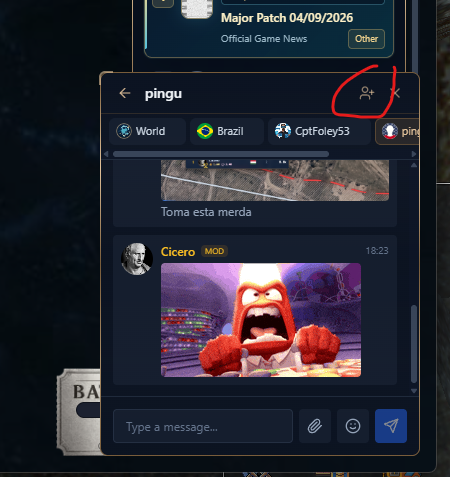
Where to find it. Your first group is opened from the header of any direct message — an add-people button that starts a group with that player already picked. The Groups section, with its own create button, appears once you are in a group, which is why you may not see it yet. An open group thread carries a gear button for its settings, on desktop and on phones. Group creation and group settings open inside the chat panel where the thread normally sits, with a back arrow.
Pictures and GIFs
Attach a JPG, PNG, WEBP, BMP or GIF — up to 10 MB, or 5 MB for an animated GIF — with an optional caption of up to 250 characters. One attachment per message, and a picture with no text at all is fine.
There is a GIF search built into the composer, as a second tab of the emoticon button. Results are rated pg-13. GIFs are provided by GIPHY.
Images render inline and open full size when clicked. The conversation list previews them as "Photo" or "GIF", or shows your caption if you wrote one.
Only direct messages and custom groups accept attachments. World, Country, Local, Party, Military Unit and onboarding channels refuse them, and the server enforces that whatever the client sends.
A picked image shows as a thumbnail above the message box while it uploads, and send stays locked until it finishes, so a caption can never go out without its picture.
A group picture is stored as a 300x300 square, and that one cannot be an animated GIF.
Guest accounts cannot create groups or upload pictures. A punished player is silenced but not trapped: no creating, renaming, re-imaging, adding or sending, but they can still remove members, change roles, leave, and delete their own group.

XII. Quality of life
Every completed daily quest is worth +1 EXP from level 2, on top of its Gold and Battle Pass prestige. Complete five and that is five EXP towards your next level. The quest card shows the chip.
Firefox no longer dies on entering a battle. Blurred glass over a live map scene was killing the browser's content process; it is now painted as a tint while a war or construction scene is on screen.
A world with no wars no longer breaks the map or the dashboard. An empty war list is read as "no wars" rather than as a failure — which matters a great deal this morning.
Tapping a link in chat no longer dumps you on a blank page, and chat no longer chimes twice for the same message when the translation queue drains a backlog.
A diplomatic bill names both countries — "Georgia → Poland" — instead of reading backwards on the other side's screens.
Sharing a screen sends only the link, not a hardcoded Portuguese sentence into the recipient's chat.
A pasteable settings code now carries the dashboard layout and the map render profile, and flags the parts that belong to the author's device before you apply them.
Election day has a card in the dashboard carousel. Dismissing the floating vote reminder only snoozes it until the final hours of the ballot, and the card stays a day after the urns close, reading the results.
The Gold Mine sends a phone-gated player to verification before the travel, instead of spending energy on a trip that ends in an error.
Recruitment market-purchase milestones count again, including buys from NPC offers, and purchases already made count retroactively. The Recruitment Center now states plainly that a recruit must verify their phone before either side receives milestone rewards.
The wallet popover always offers your bank, and the war scoreboard's phone pill spells out "Victory in" instead of a bare trophy glyph.
Battle Pass reward art sits inside its own tile again on phones, at the same size on the free and premium rows.
A missile in flight traces a proper arc across the map, including across the date line.
What to do today
Presidents: check your treasury and your national storage. Two settlements landed there this morning, and your warhead stock is at zero.
Decide what your country actually wants, then buy the clock you can fight. A declaration is a purchase now: a duration, a price, and one or two named regions you intend to keep. Six captures that miss your aims settle nothing, and a missed deadline costs you a week of peace.
Check who your allies are before the shooting starts. Fighting under a flag that is neither yours nor a formal ally's costs you 30% of your damage, and you cannot sign an alliance with a country you are already at war with.
Empty your Piggy Bank before a large battle. Sixty per cent of every reward lands there and the overflow above 30 Gold is discarded.
Turn up to rounds you would previously have skipped. You are paid for the damage you deal now, whether your side wins the round or not.
Then go and read your own country's shelf in the Library. In five days of quiet somebody will write this era's chapter, and the first president of the new rules is going to be named in it.
Report anything that looks wrong. Use the in-game support ticket system for something affecting your own account, and the Discord server for rules questions and discussion. The rules above are the ones the server enforces; if the game does something else, we want to know before you have to argue about it.
Cicero