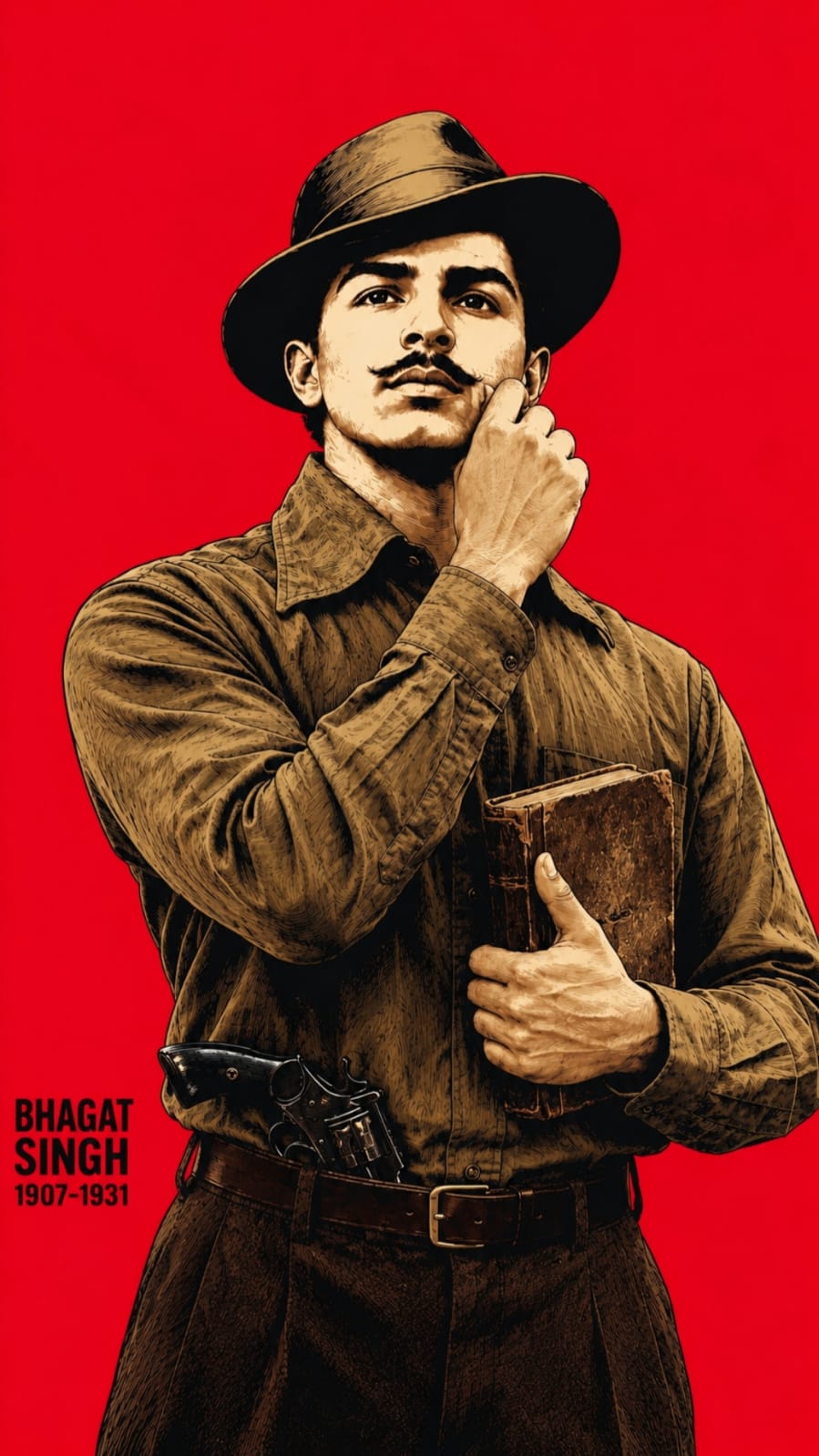
In the dusty streets of Lahore and the blood-soaked soil of Amritsar, a boy of twelve watched the British Empire reveal its true face. On 13 April 1919, at Jallianwala Bagh, troops under General Dyer fired into an unarmed crowd of Indians gathered for a peaceful meeting. Official British figures admitted 379 dead; Indian estimates put the toll over a thousand, with more than a thousand wounded. Young Bhagat Singh later walked to the site, collected soil stained with the blood of the martyrs, and kept it as a silent oath. That day planted the seed of a revolution that would cost him his life at just 23.
Www-britannica-com
Born on 27 or 28 September 1907 in Banga village (Lyallpur district, now in Pakistan) into a patriotic Sikh family already marked by anti-colonial resistance, Bhagat Singh grew into one of the sharpest minds and bravest hearts of India’s freedom struggle. He joined the Hindustan Socialist Republican Association (HSRA), turned from pure nationalism toward socialist ideas, and rejected both blind violence and empty compromise. When Lala Lajpat Rai died after a brutal police lathi-charge during protests against the Simon Commission in 1928, Bhagat Singh and his comrades decided to strike back. On 17 December 1928 they shot John Saunders, a British police officer, in a case of mistaken identity—they had targeted the official responsible for the assault on Rai. They did not hide. They proclaimed the act as justice against a system that treated Indian lives as disposable.
Wikipedia
Months later, on 8 April 1929, Bhagat Singh and Batukeshwar Dutt threw two low-intensity bombs into the Central Legislative Assembly in Delhi—not to kill, but “to make the deaf hear.” They shouted “Inquilab Zindabad” and allowed themselves to be arrested so the trial itself could become a platform. In prison they launched a hunger strike lasting over 100 days demanding better treatment for political prisoners; comrade Jatin Das died on the 63rd day. Bhagat Singh used the courtroom and his writings to expose imperialism as economic plunder dressed in the language of civilisation. On the evening of 23 March 1931—hours earlier than scheduled—the British hanged him, Rajguru and Sukhdev in Lahore Central Jail. He was 23 years, five months and a few days old. He went to the gallows reading, refusing to beg, and declaring revolution.
Wikipedia
British rule in India was not a civilising mission. It was systematic extraction. Before the East India Company seized political power after Plassey (1757), India had been a major manufacturing power, especially in textiles. British policies deliberately de-industrialised the country: high tariffs blocked Indian cloth from British markets while machine-made Lancashire textiles flooded India duty-free. Weavers were ruined; many were forced onto already overcrowded land. Dadabhai Naoroji’s “Drain of Wealth” theory, laid out in Poverty and Un-British Rule in India (1901) and earlier papers, showed how a large portion of India’s revenue—through “Home Charges,” salaries and pensions of British officials, interest on debt, profits of British companies, and the cost of imperial wars—left India every year with no equivalent return. Modern estimates by economists such as Utsa Patnaik put the cumulative drain, compounded, in the tens of trillions of present-day dollars. The same power that emptied India’s treasury then pointed at the resulting poverty and called Indians “poor” and “backward.” Theft first, then the insult.
Upscaspirants
The irony deepens when we look across the ocean. The same British Empire that ruled India had earlier colonised North America. European settlers—primarily British—dispossessed, displaced and killed Native American peoples through war, broken treaties, forced removals, and the introduction of diseases to which Indigenous populations had no immunity. Population collapses of 50–90 percent in many regions are documented in historical and epidemiological studies. The term “Red Indians” (or “Redskins”) was a colonial label, rooted in European observations and diplomacy, later carrying pejorative weight. British colonial policy in the American colonies, and later American expansion that continued the pattern, treated Indigenous land and lives as obstacles to settlement and profit. Yet some modern voices that romanticise or defend the British Empire in India remain silent—or even supportive—when the same empire’s record against the original inhabitants of the Americas is mentioned. The double standard is striking: one people’s suffering is justified as “progress,” another’s is forgotten or excused.
research.colonialwilliamsburg
Bhagat Singh saw through the hypocrisy. He understood that imperialism was not only political domination but an economic system that drained wealth, destroyed industry, and then blamed the victims for their poverty. He fought not merely for the replacement of white rulers by brown ones, but for a deeper social and economic transformation. His short life remains a factual rebuke to anyone who still softens the record of colonial cruelty or pretends the poverty of colonised peoples was their own fault.
In Eclesiar’s living world of politics, economy and struggle, remember the young man who refused to bow. Inquilab Zindabad.








 Train
Train  Fight
Fight  Work
Work 





 0
0
 0
0
 0
+
0
+
 Location








 Report