We ended the previous article with the first days of my term and the war through which we hoped to fulfill our promise of annexing Shkoder to Croatia. Today, we continue with the other events that defined my first term in office.
Two new presidents that brought us together
At roughly the same time that I came to power in Croatia, the USA also got a new president serving his first term—Sosa Sosta. His political program was based on establishing US dominance over both American continents in cooperation with Chile, effectively declaring the Americas to be the US sphere of influence. This policy pushed Poland, which was already experiencing its first tensions with Korea, to look for additional allies. Working with GhostOfForest, I concluded that both Poland and Croatia were vulnerable to attack—the USA from one direction and Sweden from the other—so we signed a bilateral defensive pact under which, in the event of aggression against either country, the other would be obligated to come to its defense.
While negotiating and signing the pact, I thought this would be the decision that dragged me into another war. As it turned out, I was wrong and it will drag Poland. Macedonia was unhappy with our intervention, and after the many insults exchanged between both sides, it began looking for revenge. Thanks to its good relationship with the Swedish government, Macedonia managed to persuade the WET alliance, which Portugal had recently joined, to return SAF to Portuguese control and, in doing so, strip Croatia of its newly acquired colonies. Sweden soon attacked with the support of the WET alliance. Croatia was defended by Korea, acting as an ad hoc ally because of the war in Macedonia; Serbia and China, who honored their commitments as members of the South Wind alliance; and Poland, which had only recently signed its defensive pact with Croatia. Unfortunately, Croatia was exhausted after fighting two wars within a single month. Korea and Serbia had also depleted significant resources during the war in Macedonia, while Poland had not yet become the superpower it is today. Against the WET alliance, it simply wasn't enough.
First lost war
Ever since the day Manga threatened Australia and Portugal joined WET, we had been aware that intervention over SAF was a real possibility. When it finally became clear that we had lost the colonies, however, something happened that none of us expected. I still remember sitting in a café with SPMarine next to me, mildly under the influence after finishing third in a darts tournament. It was Saturday, around 10 p.m. I had just joined him and ordered a drink when my phone vibrated. An Eclesiar notification appeared on the screen. I opened the app and read:
Aggression has been detected. Bosnia and Herzegovina declared war on you.
A member of a defensive pact had just decided to attack another member of that very same pact—probably the first and last time anything like that happened in Eclesiar. When I asked Ćiro whether he had lost his mind and whether he could see that we were already at war with WET, his response was simple:
Sign a NAP. Not my problem.
The war began because of certain accounts that had been registered in Bosnia and Herzegovina. Manga had most likely created those accounts in an attempt to destabilize the country, apparently out of anger that Bosnia and Herzegovina had not helped us in Africa when WET attacked. We can safely give him at least half the credit for kicking Croatia while it was already on its knees.
The attack on Zadar began immediately, striking what remained of our core regions because, thanks to geography, Bosnia and Herzegovina has a border with practically all of them. We lost flat Zadar, after which Zagreb was attacked and lost as well. Poland and Serbia rushed to our aid, but with Bosnia and Herzegovina enjoying a massive bonus, fully stocked storages, and unlimited use of adrenaline, we had little chance after everything we had already spent fighting WET.
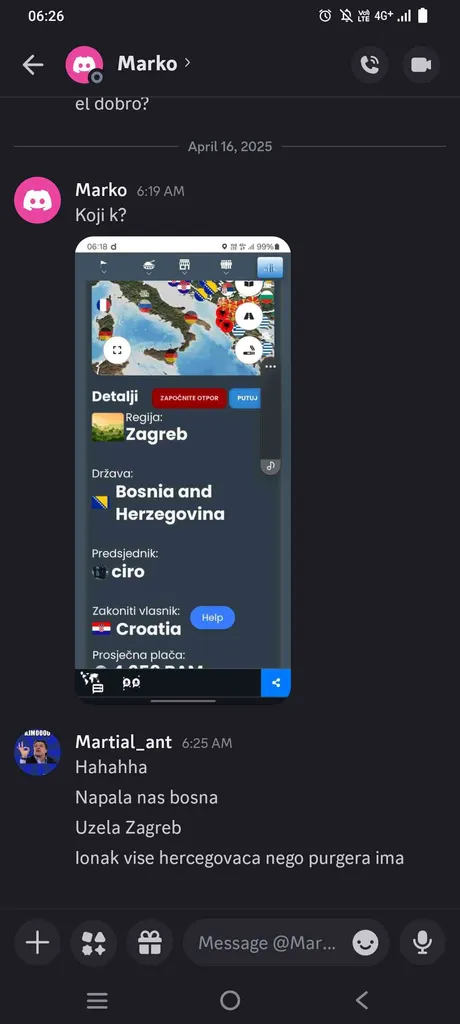
Marko: What the f...
Martial: Bosnia attacked us, they took Zagreb. There is anyway more Herzegovinians there than those who are born there.
The situation finally began to change after we lost those two regions, where Bosnia and Herzegovina had enjoyed a strong bonus. Forced to attack desert terrain without a desert squad, their advantage disappeared, allowing us to easily repel the attack and retake Zagreb. After turning the war around and entering Bosnia and Herzegovina's flat regions, however, we realized that we had reached our limit. Our storages were empty and we simply had nothing left with which to continue the war, while Poland was unwilling to participate in an offensive against Bosnia and Herzegovina's core regions.
And then the second thing we least expected happened: Macedonia declared war on Bosnia and Herzegovina. It turned out that Ćiro had believed Croatia was actually powerful at that moment — what a mistake. He had declared war on us as an act of revenge, believing that it would be impossible for us to win — another mistake. He then asked Macedonia to wipe Bosnia and Herzegovina so that Croatia wouldn't occupy the country, hoping that at least some of its infrastructure could be preserved. Oh boy, what a mistake that was too.
Aftermath
Croatia was left in ruins. Bosnia and Herzegovina was devastated because of a disastrous miscalculation. Serbia had completely emptied its resources. South Wind was dissolved. Poland and Korea had burned through significant portions of their stockpiles. And yours truly had just completed the worst presidential term in Croatian history—both up to that point and, as it would turn out, ever—and had absolutely no chance of being reelected in the upcoming elections.
Everything that happened during this period would come back to haunt these countries in the following month, especially Poland, Korea, and China—the latter being one of the few members of the South Wind alliance that didn't understand the endless Balkan quarrels but nevertheless honored its word and fulfilled its obligations. More about that in the next edition.
As always, the Premium edition contains screenshots of several events from the period covered in this article.







 Train
Train  Fight
Fight  Work
Work 




 0
0
 0
0
 0
+
0
+
 Location






 Report

 MOREEEEEEEEEEEEEEEE