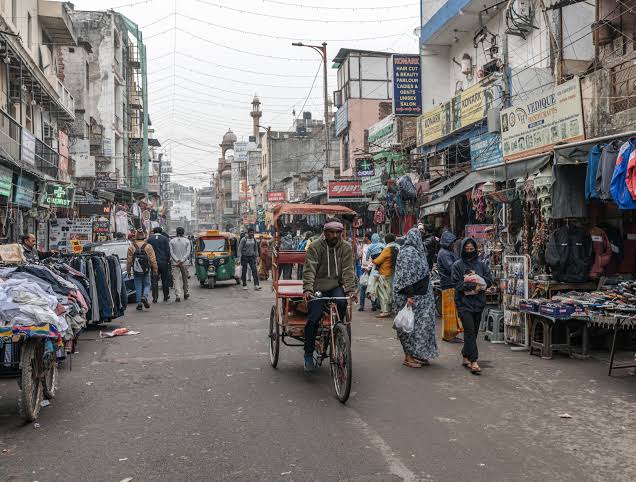
On paper, the Indian economy is a global powerhouse. To global investors and macroeconomic analysts, it is the shining star of the post-pandemic world—a nation whose numbers consistently defy global slowdowns. But step out of the corporate boardrooms and onto the bustling streets, and a much more complex, uneven reality emerges. The story of India today is a tale of two distinct economies operating simultaneously.
The Macroeconomic Miracle
If you look at the national ledger, there is plenty to celebrate. India remains one of the fastest-growing major economies in the world, with recent quarters posting robust real GDP growth rates of around 7.8% to 8.2%.
The nation is currently the world's fifth-largest economy and is firmly on track to claim the number three spot by 2030, with a projected GDP of over $7.3 trillion. This momentum is largely driven by a booming services sector, healthy government capital expenditure, and strong domestic demand from the upper-middle class. Tax collections, like the GST, have shown strong double-digit year-on-year growth, indicating solid economic activity at the formal level.
By these metrics, the engine is roaring.
The View from the Ground: A K-Shaped Reality
However, GDP is just one way to measure an economy's health—and it rarely captures how wealth is distributed. Ground-level economic indicators point to a "K-shaped" growth trajectory. While the upper leg of the 'K' reflects surging corporate profits, luxury consumption, and a booming stock market, the downward leg reveals a working and middle class that is feeling the squeeze.
The Employment Challenge
Normally, consistent 7% plus GDP growth would yield millions of secure, formal jobs. In reality, employment remains a severe pain point. While overall employment numbers may look stable, the quality of jobs is shifting. In the absence of massive manufacturing job creation, many workers have been forced back into the agricultural sector post-pandemic.
Meanwhile, urban youth are increasingly turning to the gig economy. Millions now work as delivery riders and drivers—roles that provide immediate income but lack job security, health benefits, or upward mobility.
Household Budgets Under Pressure
The most telling sign of ground-level stress is how families are managing their money. Net financial savings have struggled to rebound from historic lows, and household debt as a percentage of GDP rose to 41% in FY24. By early 2025, over 28 crore (280 million) borrowers had pending loans, with the average debt amount climbing roughly 40% since 2021. Simply put, many families are taking on debt just to maintain their standard of living.
Rural Distress and Inflation
Nearly 63% of India’s population lives in rural areas, generating about 46% of the national GDP. This massive segment of the population remains highly vulnerable to climate shocks. Erratic monsoons and severe El Niño conditions directly threaten crop yields and rural wages. While headline inflation has hovered around a moderate 4.3% to 4.7%, the cumulative cost-of-living increases over the past few years have heavily eroded the purchasing power of daily wage earners and the lower-middle class.
The Path Forward
India's macroeconomic strength is not an illusion—it provides a crucial buffer against global instability and attracts essential foreign investment. But for the economy to truly thrive, the wealth generated at the top must find its way to the bottom.
The real test of India’s economic ascent will not be how fast it reaches a $5 trillion or $7 trillion GDP, but whether it can transition its massive informal workforce into secure jobs, ease the debt burden on its middle class, and ensure that the next phase of growth is felt in the narrow lanes of its street markets just as strongly as it is in its financial capitals.








 Train
Train  Fight
Fight  Work
Work 





 0
0
 0
0
 0
+
0
+
 Location








 Report